Chapter 7
The Pyramid
"Cultural amplification over transformation. If a framework can't guide a friend, it won't guide a Fortune 500."
The Pyramid Framework did not start in a consulting engagement. It started with a phone call from a close friend who had just been promoted to a leadership role in a global aviation company and was drowning. He had the title. He had the team. What he did not have was a roadmap for translating corporate strategy into operational reality without losing his people along the way.
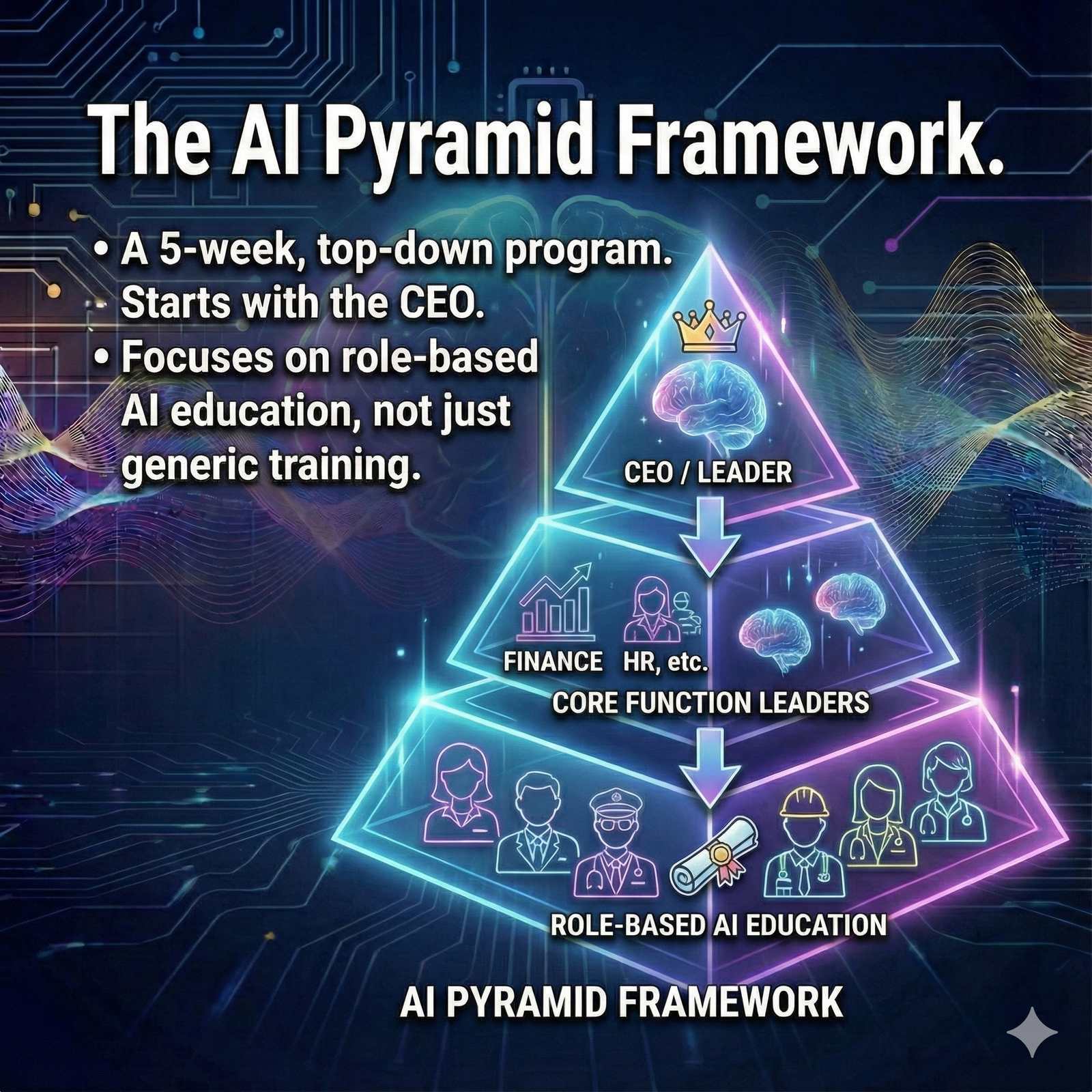
I sketched the first version of the Pyramid on the back of a notebook during that call. Three tiers: Executive, Functional, Operational. Each tier with its own language, its own concerns, its own definition of success. The insight was simple but powerful: transformation fails not because the strategy is wrong, but because it is communicated in a single language to an audience that speaks three.
The Three-Tier Architecture
At the Executive tier, the language is strategic: vision, market position, competitive advantage, ROI. At the Functional tier, the language is operational: processes, timelines, resource allocation, team capability. At the Operational tier, the language is practical: daily tasks, immediate deliverables, individual performance, job security.
A strategy expressed only in executive language can leave functional and operational teams to make their own translations. The three-tier Pyramid I sketched addressed that gap by asking what the change meant to each group and how it could be discussed in terms they recognised.
"You do not convince an operational team to embrace AI by showing them a board presentation. You show them how AI makes their Wednesday afternoon easier."
Making Adoption Meaningful
In the work that followed, I paid closer attention to how people interpreted the proposed change. Adoption meant more than access to a system. It meant understanding its relevance, trying it in real work and being able to raise concerns when it did not fit.
The reason for this performance is not complexity. It is the opposite. The Pyramid works because it respects the reality of how organizations actually function: as multi-layered systems where each layer has legitimate concerns that must be addressed in its own terms — the operational team is convinced by what AI does for a Wednesday afternoon, not by a board presentation.
The Personal Test
I hold every framework to a personal test: Can it guide a friend through a career crisis? If the answer is no — if the framework only works in a corporate context — then it is incomplete. My friend in aviation used the Pyramid to align his teams, elevate vendor management standards, and secure measurable results within his first year. My nephew used it to distinguish himself in a graduate induction program with fifty peers. If a framework can do both, it is ready for a Fortune 500.
From the personal archive